
Read the Howard County Owner-of-Record Card
For a fast answer on the owner of record, pull the official SDAT card. It serves as Howard County's most current assessment record. Treat it as evidence, not a legal opinion, and keep its labels intact when you copy anything.
| Owner Name | Individual or entity carried on the assessment account |
|---|---|
| Mailing Address | Destination for assessment correspondence |
| Premises Address | Physical location of the parcel |
| Account Number | District plus six-digit account identifier for county code 14 |
| Deed Reference | Book/page bridge to Maryland Land Records |
| Sale and assessment fields | Dated context, not independent proof of current title |
The Owner Name field names the holder of title, not who lives there. A mailing address may differ from the premises address for an estate, association, farm, entity, or any owner who gets notices elsewhere. Read both fields carefully.
Check Howard County Current Account Owners
Start at the SDAT Real Property Data Search. Choose Howard County. Then search by address, street, property account identifier, or map reference. SDAT does not support owner-name, town, neighborhood, subdivision, or ZIP search. Drop directional words and street-type suffixes from addresses. Add a trailing asterisk to widen a shortened street name. A deleted account surfaces only through its account identifier.
Once results appear, copy the account, premises address, Owner Name, mailing address, and Deed Reference. Copy them as a set. That keeps your owner-of-record claim tied to the right parcel.
See the Howard County Search Entry Point
The official SDAT county-selection page shows the supported routes to the owner-of-record card.
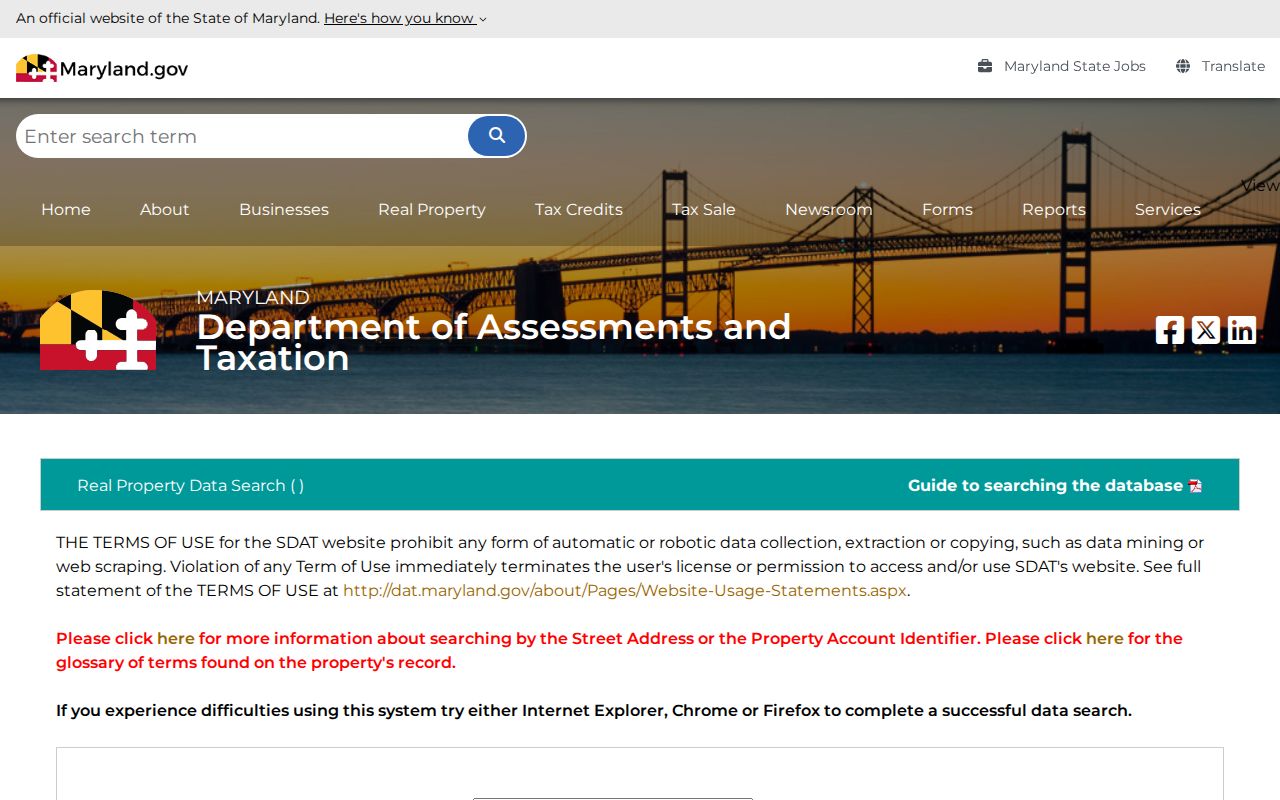
The search screen itself carries the key lesson. Start from the property, never from an owner name. Then carry the account number and deed reference forward into the confirmation step.
How Current Is Howard County's Owner Record?
Howard County keeps no published standard. None says how long a deed takes to appear in SDAT's ownership data. So a fixed delay should never be promised. After a closing, compare the dates on the assessment card. Then check the recording date in Maryland Land Records. That side-by-side check tells you more than any rule of thumb. A freshly recorded deed can leave the old name sitting on the tax roll. That can go on for a while. SDAT also mails new owners homestead-credit application information. This happens once the deed is recorded and its records update. Connected systems do not move at the same moment. In other words, patience pays off.
Recent-sale gap. The roll can lag a transfer. The newest recorded deed is the more current public evidence of the named grantee.
Interpret Current Howard Entity Owners
The Owner Name field is not limited to people. An LLC can hold that spot in Howard County property records. So can a trust, a homeowners association, or an estate. Copy the name exactly as written. Then read the grantee wording and legal capacity on the latest deed. Maryland Business Express helps identify a business entity and its registered agent. Still, that corporate record is no substitute for the deed itself. A trustee or personal representative may act in a stated capacity. Describe the capacity plainly. Do not claim who benefits from a trust or who actually lives there. Maryland's Safe at Home program supplies substitute addresses for eligible participants. Treat any mailing address as just that.
Confirm Howard Current Owners by Deed
Let the assessment reference be your bridge, not a broad name search.
- Copy Owner Name, account, premises, and Deed Reference from SDAT.
- Open Maryland Land Records, select Howard, and jump to the stated book/page.
- Confirm the parcel or legal description and the grantee named in the deed.
- Check for a still newer related conveyance before describing the current owner.
- Owner of record
- The party named in the relevant public ownership record.
- Assessment roll
- SDAT's informational ownership and value account data.
- Recording lag
- The interval before one system reflects a deed recorded in another.
- Situs
- The parcel's physical premises address, not the mailing destination.
Reach Howard County Owner Records Offline
Offline options remain strong. The SDAT Howard office sits at 3451 Court House Drive in Ellicott City. Hours run 8:00 a.m. to 4:30 p.m., and the phone is 410-480-7940. Land Records occupies Suite 1900 at 9250 Judicial Way. Recording service there runs 8:30 a.m. to 3:30 p.m. at 410-313-5850. Confirm hours before you drive over. Workstations at the courthouse and the Maryland State Archives offer free land-record access. Remote Maryland Land Records access changed in November 2025. The new system requires fresh accounts, two-factor authentication, and one-device use. Pages newer than 100 years may cost $0.20 each when pulled remotely. If a county-held record is missing from a portal, email a focused MPIA request to piarecords@howardcountymd.gov. Name the address, account, record, and date range.
Note: The clerk provides self-research access and copies but cannot perform a title search or give legal advice.
Tax-Sale Names Are Not New Owners
The Howard County tax-sale list is public, and it carries a lot of detail. Columns can include the parcel number, owner name, property address, assessed value, and sale amount. The owner entry helps you match a delinquent account to the right SDAT parcel. What it does not do is change who the current owner of record is. A winning bidder gets a lien certificate, and the parcel stays tied up in Maryland's redemption and foreclosure process until that runs its course.
If you need a present-day owner, go back to the dated SDAT card and the newest deed in the Howard County Land Records Department. Treat the tax-sale list as proof of a delinquency, not a conveyance. That framing also keeps the assessed value, lien amount, and sale amount from being confused with the consideration stated in deed records. Questions about a tax bill or the sale itself go to the Howard County Department of Finance at 410-313-2062 or 410-313-2299, while ownership and deed questions belong to SDAT and Land Records.
Use Howard Owner Addresses Responsibly
An assessment mailing address is the official contact clue attached to the account. It is not proof of residence. A short property-related letter works best. It should name the parcel and the reason for contact. Skip any claims about occupancy.
To trace an address to its owner, use the Howard County ownership method. For earlier names on the parcel, follow the former owners trail.
Lawful use. Public owner information supports property diligence and legitimate correspondence. Never use it to stalk, harass, intimidate, or harm anyone.
Read Howard Latest Deed Results
A Maryland Land Records result for Howard County carries real detail. Recording date, party names, instrument type, book and page, remarks, and an image link all appear in one row. Check the Party Type field first. It separates grantor from grantee, and the Ownership field splits corporate results from individual ones. When names miss, the search modifiers earn their keep. Exact-style matching, Begins With, Contains, Fuzzy, and Soundex absorb differences in punctuation, spelling, and entity names. Matching the grantee to the right parcel is the whole point. A newer conveyance can sit just above an older one in the results.
Remember that the result row is only an index. Open the instrument itself. Read its legal description, parcel or plat reference, stated capacity, and exceptions next to the SDAT account. A trustee, personal representative, or company agent is acting in that role, not necessarily holding beneficial ownership. The same caution applies to instrument types. A mortgage, deed of trust, release, easement, or judgment is not a deed just because an owner's name shows up in it.
Howard County's recording workflow adds a helpful checkpoint of its own. A deed moves through the county Finance recordation process before it reaches Land Records. SDAT keeps its assessment account on a separate track entirely. That split explains why the deed image, the assessment owner, the tax mailing address, and the tax bill rarely change on the same day. No public source publishes a standard roll-update interval. The dependable approach is to cite the date on each record rather than assume every system agrees at once.
Need only a copy? Maryland Courts lists a statewide deed-copy price of $0.50 per page, though it pays to confirm Howard's current counter charge. The clerk keeps no original deed, gives no legal advice, and performs no title search. Those limits simply frame what a public-record comparison can do. Set the newest recorded grantee beside the SDAT owner card and see whether they line up.